Now’s your chance. The free time you were waiting for. You can finish all of those projects. Start working out. Learn a new skill. Reconnect with your family. You can finally write that novel you’ve been putting off. But alas, you’re a week in, and all you’ve successfully done is watch all of Tiger King and drank a lot of wine. And to top it off, now you want to kill your family.
Whether you’re working from home, laid off, trying to manage a household of kids, or stuck by yourself, this isn’t really a “vacation” for anyone. We’re all having to get used to the “new normal,” and in these times of intense change and uncertainty, we tend to either Flourish or Perish.
Being quarantined, and furloughed, I’ve seen a million posts on my daily scrolls through Instagram telling me what I should be doing with my newfound free time. Then another million aimed at making me feel better for NOT “flourishing” in this time of uncertainty. In the end, though, some influencer or celebrity isn’t going to be able to tell me what I should be doing. The same goes for you. If you want to truly use this time in a way that is fulfilling and productive, you’re the only one who can figure out what that means.
So here comes the easy part. Think about your life.
What are you missing? (how easy it is to start with the negative, right?) What do you think would make you happier? What are you proud of? What do you feel genuinely grateful for? If you’re struggling to figure out how to utilize your new free time, start by looking into what’s already there.
Try putting it into writing, try telling someone. Can you break down what you’re looking to achieve, gain, or change in these next few weeks? If you’re able to clearly break it down for someone else or to put in writing, then you’ll better be able to identify it for yourself.
So, the hard part? Do something about it.
Steve once told me that he’s not the best at working out (yea, probably a moment of weakness on his part… but he said it) but that he’s good at it because he does it every day. So, if you want to write, park yourself at the computer and type out a paragraph or two, every day. Want that toned body? Tune in to a free online workout class every morning (or call up steve if you’re really serious about it). If you want to reconnect with your family, don’t expect that you’ll suddenly be able to hang out with an angsty pre-teen for weeks on end without wanting to pull your hair out, maybe you start by preparing dinner together or working on a puzzle… you guessed it, every day.
It’s ok if after this has settled down and you’re heading back to work, that you don’t have a manuscript to forward off to publishing houses worldwide. It’s ok that your bikini body is only tankini ready, or if your kids are just as eager to get away from you as you are for them.
But if given the opportunity to flourish or perish, don’t believe for a moment that your only option is to perish because you don’t have what it takes to flourish. Do what you love, what’s important to you, what you’ve been putting off…. And even if it’s just a little bit, do it every day. Take this time to create habits and to start. Take this time to learn how to flourish.
-Katherine Kline
Friday, March 27, 2020

Monday, February 10, 2020
Why I Gave Up 2 of my favorite things this January… and Why You Shouldn’t
Halloween, Thanksgiving, Christmas, and New Year’s Eve are all within 60 days of each other. For so many, it’s their favorite time of the year, and it’s clear to see why. It feels like every day is packed with outings, traveling, visiting family, great food, better desserts, and a ton of booze. For me, it’s no different. So when my business picked up this fall, I was trying to fit in balancing work, a social life, family obligations, and enjoying this time of the year, I did what so many of us do. I savored every type of instant gratification I could get my hands on. I’d power through a long day at work and rush to some seasonally appropriate party, where I’d gorge myself on heavy fall/winter dishes, washing it down with red wine or tumblers of whiskey. I’d come home both mentally and physically exhausted and would have a drink to relax. After a drink or 2, I would end up polishing off any leftovers. 5am would come early of course, and I’d be off to do it all again. This time, feeling the gluttony of the night before weighing me down, making me even less likely to do my own workouts or focus on my own goals.
Enter New Years Day and the start of “Resolution Season.” I knew I needed to make a change, and I knew for myself, it needed to be radical. Dry January has become more and more popular, but I needed to take it to the next level. I needed to give up Alcohol and Sweets…. Cold turkey.
I know what you’re thinking… I’m crazy! But for me, it worked and was exactly what I needed. Telling clients about my Extra Dry January though, I got a lot of questions concerning whether or not THEY should be following my example and dropping all of their major vices cold turkey for an entire month. That answer is a plain and simple, HELL NO! And here’s why.
Goals are an incredibly specific and personal thing. Whether I’m writing my own or looking at the goals of a client, it’s imperative to consider every aspect of their lives. Here are some things to ask yourself:
What is my starting point?
What is my long term goal?
How long do I want it to take to achieve this?
What am I willing to sacrifice? What am I NOT willing to sacrifice?
How motivated am I?
How can I break this down into achievable steps?
It’s not until we break it down into reasonable short term goals that we can look at what aspects of your life you should change. All short term goals are habit changing, and they should be progressive in nature.
For example, if you’ve eaten an entire cake every day for 5 years, cutting that out cold turkey isn’t going to be very effective. Cutting it out cold turkey for one month is going to be even less effective. For starters, you’ll be miserable, and not very likely to keep with it. Once the month is up, you might feel like you instantly want to splurge and end up right back where you started.
A more manageable goal would be to eat HALF a cake every day, or to cut out cake ONE day a week at first. Then you can gradually continue to decrease your intake.
But why wouldn’t I practice what I preach? How can I say that YOU shouldn’t do it, and when it was my January Goal and worked for me?
For me, this is what helps to motivate me. I respond highly to extremes, and it fit into my long term and yearly goals. Having a month to take a break from the things that usually bring me instant gratification gave me the opportunity to reevaluate my priorities, my time management, and gave me the chance to expand what I felt gratification from.
I’ve also given up these things for short amounts of time before. At first, just cutting it out one or two days a week, then a week or two at a time, and have done lengths up to several months even. But I’ve never cut out TWO of my favorite vices for one month before, so it was time to take the step toward this challenge.
The point is, you need to focus your goals on just that… YOU! And I can help with that.
If you or someone you know is struggling to achieve their health, wellness, fitness, or nutrition goals I can help. What I do is so much more than “personal training”. It is all-encompassing health & wellness specifically focused on YOU! If you’re ready for real change and not afraid to put in work, I am currently taking new in-person clients. You can contact me via the ways listed below.
Be well!
Enter New Years Day and the start of “Resolution Season.” I knew I needed to make a change, and I knew for myself, it needed to be radical. Dry January has become more and more popular, but I needed to take it to the next level. I needed to give up Alcohol and Sweets…. Cold turkey.
I know what you’re thinking… I’m crazy! But for me, it worked and was exactly what I needed. Telling clients about my Extra Dry January though, I got a lot of questions concerning whether or not THEY should be following my example and dropping all of their major vices cold turkey for an entire month. That answer is a plain and simple, HELL NO! And here’s why.
Goals are an incredibly specific and personal thing. Whether I’m writing my own or looking at the goals of a client, it’s imperative to consider every aspect of their lives. Here are some things to ask yourself:
What is my starting point?
What is my long term goal?
How long do I want it to take to achieve this?
What am I willing to sacrifice? What am I NOT willing to sacrifice?
How motivated am I?
How can I break this down into achievable steps?
It’s not until we break it down into reasonable short term goals that we can look at what aspects of your life you should change. All short term goals are habit changing, and they should be progressive in nature.
For example, if you’ve eaten an entire cake every day for 5 years, cutting that out cold turkey isn’t going to be very effective. Cutting it out cold turkey for one month is going to be even less effective. For starters, you’ll be miserable, and not very likely to keep with it. Once the month is up, you might feel like you instantly want to splurge and end up right back where you started.
A more manageable goal would be to eat HALF a cake every day, or to cut out cake ONE day a week at first. Then you can gradually continue to decrease your intake.
But why wouldn’t I practice what I preach? How can I say that YOU shouldn’t do it, and when it was my January Goal and worked for me?
For me, this is what helps to motivate me. I respond highly to extremes, and it fit into my long term and yearly goals. Having a month to take a break from the things that usually bring me instant gratification gave me the opportunity to reevaluate my priorities, my time management, and gave me the chance to expand what I felt gratification from.
I’ve also given up these things for short amounts of time before. At first, just cutting it out one or two days a week, then a week or two at a time, and have done lengths up to several months even. But I’ve never cut out TWO of my favorite vices for one month before, so it was time to take the step toward this challenge.
The point is, you need to focus your goals on just that… YOU! And I can help with that.
If you or someone you know is struggling to achieve their health, wellness, fitness, or nutrition goals I can help. What I do is so much more than “personal training”. It is all-encompassing health & wellness specifically focused on YOU! If you’re ready for real change and not afraid to put in work, I am currently taking new in-person clients. You can contact me via the ways listed below.
Be well!
Stephen Cornely
steve@triadwellnessphilly.com
973-886-4034
www.triadwellnessphilly.com
Facebook: Triad Wellness Philly
Instagram: @stephenjcornely
LinkedIn: Stephen Cornely
steve@triadwellnessphilly.com
973-886-4034
www.triadwellnessphilly.com
Facebook: Triad Wellness Philly
Instagram: @stephenjcornely
LinkedIn: Stephen Cornely
Monday, September 2, 2019
I CAN sit Cross-legged....But now I can't get up!
So you can sit on the floor comfortably? Where do we go from here?!
Can you stand back up from the floor? Can you stand back up after a fall? What if you hurt your arms in said fall? Are you still strong and capable enough to get back up? And does it even matter?
The first reason it may matter to you is because of a study done in 2012 that linked people's ability to sit and stand from the floor with all-cause mortality. People who were able to sit on the floor and stand up with less limb support were found to live longer. On average people who had more trouble getting up were twice as likely to die in the six years following the study!
Here is a link to a news article that describes the test:
The first reason it may matter to you is because of a study done in 2012 that linked people's ability to sit and stand from the floor with all-cause mortality. People who were able to sit on the floor and stand up with less limb support were found to live longer. On average people who had more trouble getting up were twice as likely to die in the six years following the study!
Here is a link to a news article that describes the test:
http://discovermagazine.com/2013/nov/05-sit-down
For those more science-minded, here is a link to the study:
https://journals.sagepub.com/doi/abs/10.1177/2047487312471759
SO you’re still thinking to yourself, “Well I never want to sit on the floor anyway, so why does this pertain to me?” How about a beach chair or a car that’s low to the ground (think sports car)? What if you need something in a floor level cabinet or under the bed? Are your legs strong and mobile enough to get you into and out of these difficult positions? Training to sit and stand from the floor would equip you with the physical capacity to perform in all these other situations!
And the most important reason for being capable of sitting on the floor is because of what evolution tells us about ourselves. We evolved from animals that sit and lay on the floor comfortably. Early humans were capable of sitting and sleeping on the floor comfortably for extended periods of time. Being able to manipulate your body into comfort while on the floor is part of being human.
So what do you do to facilitate your body’s natural ability to sit on the floor comfortably and consequently be able to get up?
Here are a few basic stretches and strengthening drills to get you to that point:
Wall Butterfly Stretch
Straddle Capsular Hip CARs
90/90 Switch Lv1
Kneel to Half Kneel
Low Lunge Lift Off
These exercises are only the beginning! There are hundreds of ways to get up and down from the floor! There are thousands of deficits that could be causing you pain or the inability to do this natural maneuver! Your best bet is to get assessed and then start your quest!
I suggest you speak with a fitness professional, preferably a Functional Mobility Specialist before starting on your journey to regain/improve/master this basic human movement!
Thanks for reading,
Steve Cornely
For those more science-minded, here is a link to the study:
https://journals.sagepub.com/doi/abs/10.1177/2047487312471759
SO you’re still thinking to yourself, “Well I never want to sit on the floor anyway, so why does this pertain to me?” How about a beach chair or a car that’s low to the ground (think sports car)? What if you need something in a floor level cabinet or under the bed? Are your legs strong and mobile enough to get you into and out of these difficult positions? Training to sit and stand from the floor would equip you with the physical capacity to perform in all these other situations!
And the most important reason for being capable of sitting on the floor is because of what evolution tells us about ourselves. We evolved from animals that sit and lay on the floor comfortably. Early humans were capable of sitting and sleeping on the floor comfortably for extended periods of time. Being able to manipulate your body into comfort while on the floor is part of being human.
So what do you do to facilitate your body’s natural ability to sit on the floor comfortably and consequently be able to get up?
Here are a few basic stretches and strengthening drills to get you to that point:
Wall Butterfly Stretch
Straddle Capsular Hip CARs
90/90 Switch Lv1
Kneel to Half Kneel
Low Lunge Lift Off
These exercises are only the beginning! There are hundreds of ways to get up and down from the floor! There are thousands of deficits that could be causing you pain or the inability to do this natural maneuver! Your best bet is to get assessed and then start your quest!
I suggest you speak with a fitness professional, preferably a Functional Mobility Specialist before starting on your journey to regain/improve/master this basic human movement!
Thanks for reading,
Steve Cornely
www.triadwellnessphilly.com
IG: @stephenjcornely
FB: Triad Wellness Philly
Monday, August 26, 2019
I Can’t Sit Cross-Legged Style! Can You?
Well, now I can, but I couldn't. At one point in my life, I couldn't sit on the floor comfortably in any position! Think about that ...I just said sitting on the floor was HARD! I remember from elementary school all the way through junior high during assemblies in the gym and students would sit on the floor - sometimes for a few hours at a time... I always felt tight no matter what position I was in. If I sat cross-legged, my hips and ankles would kill me! My hips were unable to open up and so my ankles would have to twist immensely for me to even try to get to that position! Below you will find pictures of what me sitting on the floor looked like 5 years ago compared to now (note: the before pics are reenacted in my small condo hallway).


If I tried sitting with my feet out in front of me I would be totally hunched over putting a lot of strain on my neck and back!


If I decided to put my hands behind me to create a little support my shoulders and neck would start to hurt from the extreme tension!


No matter the position, I could never really feel my sit bones (ischial tuberosity) on the floor. (see picture below)
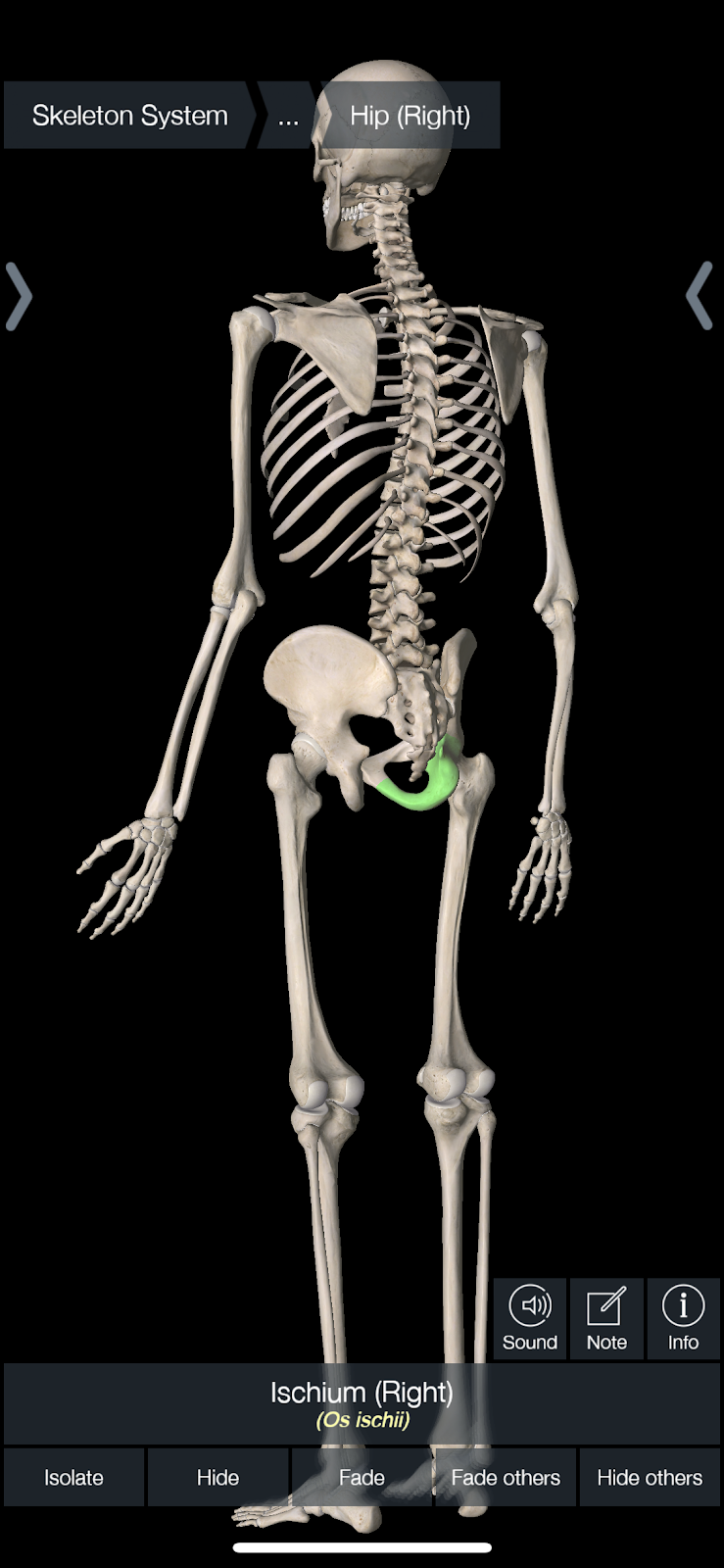

The most comfortable position I ever found was sitting on my butt on a portion directly superior to the sit bone with my knees bent and my hips externally rotated and my back very rounded ...much like a sad bear.


At first, I wondered why I couldn’t sit comfortably like my peers. I knew I was bigger than everyone else so maybe there was some fat mass getting in the way of joints moving in their greatest range. Maybe my connective tissue was just more dense than others’ because my limbs were heavy and could produce a lot of force so the connective tissue adapted to be stronger and thicker and less mobile? Whatever the reason was, I knew it didn’t matter and that I wanted to be comfortable on the floor. So what did I do? I started figuring out what was limiting me and working to mobilize and increase joint capacity in those areas. More on this in part 2!
Can you sit on the floor comfortably?
If you're interested in some exercises to help you get more comfortable on the floor and help prepare you to stand up stay tuned for Part 2 which will be up later this week!
Thanks for reading!
Stephen Cornely
www.triadwellnessphilly.com
FB: Triad Wellness Philly
IG: @stephenjcornely
Thursday, June 13, 2019
Are you Getting the Most Out of Every Breath you take?
The diaphragm. Do you know that muscle? I’m willing to bet that if you ask some health and fitness professionals, they will have no idea what the basic characteristics of this muscle are and why it is important in movement.
The diaphragm is a muscle that is shaped like an umbrella which sits right underneath your rib cage. Although its primary function is that of breathing, it also plays a large role during movement by assisting in moving and stabilizing the rib cage and spinal column.
Just like every other muscle in the body, it can be trained to be more efficient in its movement, stronger in its force production, and to become more flexible.
The first step in creating change in the diaphragm is recognizing your level of control over it. So, how do you know if you are in control of your diaphragm? Try this;
Step 1
Wrap a belt snuggly around your waist. You can use your belly button as a marker - lay the belt on top of it.
Step 2
Lay on your back on a stable surface with your knees bent at 90 degrees, with your hands and feet flat on the floor.
Step 3
Place your spine in a neutral position; said differently, just lay normally/comfortably/naturally.
Step 4
Start a slow and steady breathing pattern, preferably with a 4-8 second inhale and a 6-12 second exhale, slow and steady.
Step 5
Use the belt as feedback. You should feel your back, sides and front of the torso expand into the belt as you inhale. As you exhale the belt should become looser on all sides of the body.
This is where the magic happens: You must try to inflate the 360 degree area of the belly, sides and back. Many people can properly inflate their belly but their back and sides don’t expand at an equal rate!
The torso should expand like a balloon does, equally all the way around. The belt is a great tool to provide you feedback of which points on your torso you have difficulty breathing into.
Spend 2 minutes a day practicing this technique. As you become comfortable with it, try carrying it over to times you find yourself sitting, standing, side lying, or even moving. Being able to expand the torso equally on all sides is an external way to see that the diaphragm is contracting efficiently on all sides. Being able to master this skill is just step one in mastering your breath, your spinal movement, and even your stress and anxiety level!
Stephen Cornely FRCms LMT
Triad Wellness Philly
www.triadwellnessphilly.com
@stephenjcornely
FB: Triad Wellness Philly
Thursday, May 9, 2019
Why You Need to Be Stretched Out!
Most people categorize a “workout” session as a time when their heart rate is elevated, they feel the pump or burn in their muscles, they sweat, and they feel sore afterward. People will spend 5 minutes MAXIMUM to cool down after their workout session by doing some generic static stretching. This minimal amount of time and effort is not enough to sustain, let alone expand, range of motion in a joint or the flexibility of a muscle.
My name is Stephen Cornely and I am a Licensed Massage Therapist, a Functional Range Conditioning Mobility Specialist, a Certified Personal Trainer, and a Licensed Kinstretch instructor. When I first started working out my goal was always to crush myself physically. Sweat pouring down my face, breathing so hard I felt like I was going to vomit, and muscles so sore I couldn’t sit on the toilet without wincing in pain! Then I discovered the power of stretching and mobility work. My own personal mobility practice has kept me injury free, made me stronger, and helped me recover more quickly from grueling workouts.
I want to bring this awesome recovery method to all of Philadelphia. Together with Philadelphia’s original premier megaformer fitness studio, Scuplt360, we have created Recover360. Recover 360 stretching sessions consist of both a passive and active component. This means that when you lie on my table there will be times of deep relaxation as well as times of intense effort! The combination of those in a single stretching session is the most effective and clear path to more body control, range of motion, flexibility, and reduced injury risk.
Using the most scientifically proven principles to design your PERSONAL stretch sessions, you can expect to reap many rewards! Some of the benefits of these sessions are:
Stephen Cornely LMT, FRCmc
www.triadwellnessphilly.com
IG: @stephenjcornely
FB: Triad Wellness Philly
My name is Stephen Cornely and I am a Licensed Massage Therapist, a Functional Range Conditioning Mobility Specialist, a Certified Personal Trainer, and a Licensed Kinstretch instructor. When I first started working out my goal was always to crush myself physically. Sweat pouring down my face, breathing so hard I felt like I was going to vomit, and muscles so sore I couldn’t sit on the toilet without wincing in pain! Then I discovered the power of stretching and mobility work. My own personal mobility practice has kept me injury free, made me stronger, and helped me recover more quickly from grueling workouts.
I want to bring this awesome recovery method to all of Philadelphia. Together with Philadelphia’s original premier megaformer fitness studio, Scuplt360, we have created Recover360. Recover 360 stretching sessions consist of both a passive and active component. This means that when you lie on my table there will be times of deep relaxation as well as times of intense effort! The combination of those in a single stretching session is the most effective and clear path to more body control, range of motion, flexibility, and reduced injury risk.
Using the most scientifically proven principles to design your PERSONAL stretch sessions, you can expect to reap many rewards! Some of the benefits of these sessions are:
- Psychological & physiological relaxation through use of breathing techniques
- Increased muscle flexibility through relaxation of nervous system
- Increased strength and capacity in end ranges of joints which can mitigate risk of injury
- Increased awareness of one’s body through increased activation of sensory and motor neurons
- Increased joint health and longevity
Stephen Cornely LMT, FRCmc
www.triadwellnessphilly.com
IG: @stephenjcornely
FB: Triad Wellness Philly
Monday, April 8, 2019
Why I Hate Shoes (nothing personal, Jimmy Choo)
As soon as we are born, we are put in shoes. Cages that prevent our naturally dexterous toes from expressing their mobility. These so called “support systems” actually hinder our true support system… the tissue and musculature in the foot, ankle and lower leg. Our legs are designed to be our connection point to the earth and support our weight for hours as we move across it! For some reason, we have been told from birth that our feet are fragile and need extra support in order to go play outside?
Until its culturally acceptable to go everywhere barefoot, I suppose I will continue to be imprisoned in the mittens that society forces on me. Don’t get me wrong, I get it. Living in a city there is no way I’m stepping outside without shoes on, and snow and ice could be tricky… but we don’t have to be in our shoes all the time. Take them off at work while sitting at your desk, or if you’re relaxing at home.
There are other steps you can take to help your feet thrive while just sitting around watching tv! Here are some preventative self care methods you can perform daily to promote the health of the bones, fascia, tendons, and ligaments in your feet!
1. Toe Spacers
Until its culturally acceptable to go everywhere barefoot, I suppose I will continue to be imprisoned in the mittens that society forces on me. Don’t get me wrong, I get it. Living in a city there is no way I’m stepping outside without shoes on, and snow and ice could be tricky… but we don’t have to be in our shoes all the time. Take them off at work while sitting at your desk, or if you’re relaxing at home.
There are other steps you can take to help your feet thrive while just sitting around watching tv! Here are some preventative self care methods you can perform daily to promote the health of the bones, fascia, tendons, and ligaments in your feet!
1. Toe Spacers
Many shoes and sneakers, and particularly dress shoes, are very tapered at the toe end. . That tapering can cause hammer toes, bunions, and ingrown toenails. Toe spacers can be easily worn around the house and promote space between the toes. I recommend starting with the small foam ones and slowly working your way up to something with more integrity like silicone or plastic. There are also socks with built in toe spacers that you might try! For an extra benefit, try wiggling and controlling your toes while the toes spacers are in place so that you learn active control of this passively spread position!
2. Ankle & Toe CARs
CAR is an acronym for Controlled Articular Rotation, which is a fancy way of saying joint circle. Remember in gym class when you did really big arm circles to warm up? Think that but much slower, more intentional, more controlled and, in this case, doing it for your ankles and toes. Slowly moving your joints daily in their fullest range of motion is quite possibly the biggest bang for your buck activity you can do for the health and longevity of a joint. Here are links to both ankle and toe CARs:
Ankle
Toes
3. Ankle Strengthening Drills
If you must wear high heels on a regular basis, know that the muscles of your lower legs are being put in passively stretched or contracted positions for long periods of time. Even when you wear sneakers or dress shoes, most of them have a heel drop. This means that the heel of the footwear is slightly higher than the toe, and that leaves your calves and your tibialis anterior (shin muscles) in passive positions.
The soles of some shoes are almost a full inch wider than the shoe itself, such that you’re more or less standing on a platform. This creates multiple problems. First, it prevents the muscles on the side of your ankle (peroneals) from working and stabilizing during gait. Eventually, not using those muscles, you will lose them. Next, if your ankle rolls off this platform, you are asking your body to deal with an intense amount of weight which can cause an ankle sprain.
Here are some beginner to intermediate drills you can do to start strengthening the ankle multiple ranges of motion.
Ankle Dorsiflexion
Ankle Plantarflexion
Ankle Inversion
Ankle Eversion
Taking care of your feet is a lifelong effort. Our feet are the most important part of the body for locomotion - they provide sensory feedback on what objects we are walking on, where our center of mass is in relation to our feet, and they produce the force that propels us across the floor! Unfortunately, the way we live and what we wear often conflicts with what is best for our health. I promise you that spending some consistent time working these simple exercises into your daily life will pay big dividends in the form of enhanced and pain-free mobility.
Stephen Cornely CPT LMT FRCms
Triad Wellness Philly
Steve@triadwellnessphilly.com
ig: stephenjcornely
fb: Triad Wellness Philly
2. Ankle & Toe CARs
CAR is an acronym for Controlled Articular Rotation, which is a fancy way of saying joint circle. Remember in gym class when you did really big arm circles to warm up? Think that but much slower, more intentional, more controlled and, in this case, doing it for your ankles and toes. Slowly moving your joints daily in their fullest range of motion is quite possibly the biggest bang for your buck activity you can do for the health and longevity of a joint. Here are links to both ankle and toe CARs:
Ankle
Toes
3. Ankle Strengthening Drills
If you must wear high heels on a regular basis, know that the muscles of your lower legs are being put in passively stretched or contracted positions for long periods of time. Even when you wear sneakers or dress shoes, most of them have a heel drop. This means that the heel of the footwear is slightly higher than the toe, and that leaves your calves and your tibialis anterior (shin muscles) in passive positions.
The soles of some shoes are almost a full inch wider than the shoe itself, such that you’re more or less standing on a platform. This creates multiple problems. First, it prevents the muscles on the side of your ankle (peroneals) from working and stabilizing during gait. Eventually, not using those muscles, you will lose them. Next, if your ankle rolls off this platform, you are asking your body to deal with an intense amount of weight which can cause an ankle sprain.
Here are some beginner to intermediate drills you can do to start strengthening the ankle multiple ranges of motion.
Ankle Dorsiflexion
Ankle Plantarflexion
Ankle Inversion
Ankle Eversion
Taking care of your feet is a lifelong effort. Our feet are the most important part of the body for locomotion - they provide sensory feedback on what objects we are walking on, where our center of mass is in relation to our feet, and they produce the force that propels us across the floor! Unfortunately, the way we live and what we wear often conflicts with what is best for our health. I promise you that spending some consistent time working these simple exercises into your daily life will pay big dividends in the form of enhanced and pain-free mobility.
Stephen Cornely CPT LMT FRCms
Triad Wellness Philly
Steve@triadwellnessphilly.com
ig: stephenjcornely
fb: Triad Wellness Philly
Thursday, March 21, 2019
3 reasons to start working out and NONE of them are weight loss!
Exercise and movement have so many benefits that it’s a shame we tend to focus only on losing weight. Exercise has a positive impact on literally every system and organ in the body including the heart, muscles, brain, and lymphatic system! In fact, we are so connected and dependent on movement, that in biology the ability to move is a characteristic necessary to classify an organism as an animal!
Although weight loss can be a driving force for many to start a workout regimen, it can also be a hindrance when our quick (and sometimes unreasonable) weight loss goals aren’t met. Unfortunately, for most this causes them to stop working out all together, and then their whole body is worse off for it. If this sounds like you, I can assure you that there are so many reasons to keep moving in your life! Hopefully learning about some of these will help you shift focus during exercise and will keep you on the right path toward health and wellness!
Reason 1: Self Care
Although weight loss can be a driving force for many to start a workout regimen, it can also be a hindrance when our quick (and sometimes unreasonable) weight loss goals aren’t met. Unfortunately, for most this causes them to stop working out all together, and then their whole body is worse off for it. If this sounds like you, I can assure you that there are so many reasons to keep moving in your life! Hopefully learning about some of these will help you shift focus during exercise and will keep you on the right path toward health and wellness!
Reason 1: Self Care
Now-a-days self care has become synonymous with meditation, Netflix binging on your couch, or visits to the spa for a Swedish massage. While all of these have their place, your body craves movement more than anything to take care of itself.
Movement pumps blood to all areas of the body. Blood contains nutrients from food intake which helps the body rebuild and repair damaged tissue...which to me, sounds an awful lot like self care!
Movement also promotes release of endorphins (or endocannabinoids, research still out on that one!) which leads to feelings of euphoria and increased positivity!
Movement also forces fluid into joints, lubricating them, which allows for pain free movement within the joint. Movement is the only way that your joints can self care. The blood supply is very low in tight areas of the joints, and the pressure created by movement literally forces nutrients and fluid into the joint. Thus, allowing the joint to perform self care.
Reason 2: Detoxification
Movement pumps blood to all areas of the body. Blood contains nutrients from food intake which helps the body rebuild and repair damaged tissue...which to me, sounds an awful lot like self care!
Movement also promotes release of endorphins (or endocannabinoids, research still out on that one!) which leads to feelings of euphoria and increased positivity!
Movement also forces fluid into joints, lubricating them, which allows for pain free movement within the joint. Movement is the only way that your joints can self care. The blood supply is very low in tight areas of the joints, and the pressure created by movement literally forces nutrients and fluid into the joint. Thus, allowing the joint to perform self care.
Reason 2: Detoxification
Let’s be honest, we all know this isn’t a real thing, right? The body naturally removes “toxins” from itself. You literally have an organ devoted to this (the liver) and a whole system that is constantly battling against foreign invaders (lymphatic system). If we need to actively do something to “detox” our body why don’t we stay drunk for days after a night of drinking?
The closest thing to detoxification that I know of is movement! Movement requires energy. To produce energy, the systems in our body have to start using what’s around and available. Stored carbohydrates and fats will be thrown into the gas tank and burned for fuel to produce movement. Unlike a juice cleanse, a method of “detoxification” through movement WILL actually lead to depletion of substances in your body.
The closest thing to detoxification that I know of is movement! Movement requires energy. To produce energy, the systems in our body have to start using what’s around and available. Stored carbohydrates and fats will be thrown into the gas tank and burned for fuel to produce movement. Unlike a juice cleanse, a method of “detoxification” through movement WILL actually lead to depletion of substances in your body.
Movement can also create sweat. Although sweat is 99% water and is not a way our body excretes “toxic” substances, it does have a cooling and refreshing effect on our body. This release of water and salt can also decrease bloat which is what is happening in most people when they go on a “detox”. Finally, movement has euphoric effects that can make us feel lighter and airier instead of sluggish and weighed down - two of the top reasons people feel like they need to do a detox!
Reason 3: Wakefulness
Reason 3: Wakefulness
It is pretty well known that movement can make you feel alert, awake, focused, and more energetic! Movement increases wakefulness (the time consciously awake solving life’s problems) by increasing blood flow, increasing oxygen transportation, increasing hormone transportation, and putting the body into a anabolic state to promote growth after a hard workout! There are a number of studies that show exercise can increase working memory, mood, and alertness. It also will help with better sleep and circadian rhythms, making sure that when you’re awake, your wakefulness is on point!
Self-care, “detoxification”, and wakefulness are all things to keep in mind when you’re starting a new exercise routine. It is helpful to write daily notes about how you’re feeling before, during, and after exercise. Specific notes on how exercise makes you feel will be motivating when you look back at them and see how far you’ve come.
Sure, weight management is important but weight is primarily dictated by nutrition NOT exercise. Shifting focus toward other reasons for working out will help you keep a healthy habit going over the long run.
Stephen Cornely
www.triadwellnessphilly.com
9738864034
FB: Triad Wellness Philly
Insta : @stephenjcornely
Self-care, “detoxification”, and wakefulness are all things to keep in mind when you’re starting a new exercise routine. It is helpful to write daily notes about how you’re feeling before, during, and after exercise. Specific notes on how exercise makes you feel will be motivating when you look back at them and see how far you’ve come.
Sure, weight management is important but weight is primarily dictated by nutrition NOT exercise. Shifting focus toward other reasons for working out will help you keep a healthy habit going over the long run.
Stephen Cornely
www.triadwellnessphilly.com
9738864034
FB: Triad Wellness Philly
Insta : @stephenjcornely
Wednesday, March 13, 2019
The most “bang for your buck” movement for shoulder, spine, and hip health!
“I don’t have enough time.”
Sound familiar? In today’s day in age, it is certainly difficult to devote the amount of time we should to taking care of our bodies. For this reason, it is best to start off small, meaning use relatively simple movements, that don’t require a lot of time, that will help you get in the habit of of devoting time to movement and other forms of self care.
This is where the Modified Diagonal Stretch comes in. It is a movement that can be performed with only only 1 piece of equipment: a wall, and who doesn’t have access to a wall 24/7 -- hell, we are trapped inside 4 of them way too much!
The modified diagonal stretch is great for beginners for a number of reasons:
- It is safe. You are on 1 knee and close to a wall, both of which reduce the likelihood of falling over. It’s an active stretch, meaning that you are in complete control of the range of motion. Thoughtful active movements make it less likely that you will force yourself into a compromised position.
- It creates movement in 4 of the bodies major bones/joints: the shoulder blade(scapulothoracic joint), the true shoulder (glenohumeral joint), the spine (vertebral joints and sacroiliac joint), and the hip (acetabulofemoral joint). Joints moving = healthy joints.
- It actively combines global rotation and global extension, two highly under trained yet highly used movements in everyday life!
- The wall is used as a block to guide the movement correctly, making it very difficult to mess this up!
Follow the link to my YouTube channel to watch me coach you through the diagonal stretch and then go try it on your own! It could be a game changer for your health, fitness, balance, strength, and mobility!
https://www.youtube.com/watch?v=2TlNAR0Y70I
And remember, the first part of starting any exercise routine is creating small manageable changes that ultimately lead to more excitement, variation, and consistency in your newly formed habit.
Steve Cornely CPT FRCms LMT
www.triadwellnessphilly.com
steve@triadwellnessphilly.com
Ig: @stephenjcornely
FB: Triad Wellness Philly
PS: Remember there is no substitute for getting assessed by a professional and having exercise prescribed to fit your needs and goals!
Tuesday, February 19, 2019
Mastering the Art of an Afternoon Nap – Finding Time to Recharge
One of the best things we can do for our health, focus, energy, and fitness is to get enough rest. Unfortunately, most people do not prioritize sleep as part of their health and wellness regimen. I have found that I function well with approximately seven hours of sleep per night coupled with a 20-30-minute nap during the day. Here are eight tips on how to incorporate a nap in your daily routine:
1. First let’s begin with prioritizing the idea of rest. If you feel like you cannot devote 15-30 minutes to a healthier you, I suggest you reexamine what and who you are living for. If you are having trouble figuring out where to find 15-30 minutes in the middle of your day, begin by evaluating how you spend your personal time. Do you use your entire lunch break to eat or do you also use that time to socialize? Do you watch TV, surf the web, scroll through social media, or take coffee breaks at work? The time is there, you simply need to identify and be purposeful with it!
2. When possible, choose the same time daily to devote to your nap. I prefer to choose a time around 2pm, which is typically a bit more than half way through my day.
3. Buy an eye mask and ear plugs and use them.
4. Put your phone on do not disturb and set an alarm for 15-30minutes and put it face down. This ensures you can fully relax knowing you will be alerted when its time to wake up while reducing distractions.
5. Find a dark, quiet, warm, comfortable space. If you work in an office, consider using any available office with a door, your car, a meeting room, or, if your office provides a quiet/nap room use it! Lock the door, draw the blinds, and sit or lay in the most comfortable position possible.
6. RELAX! Relaxation takes FOCUS. Focus on slow diaphragmatic breathing, the movement of air in and out of the lungs, and the blackness that you see when you close your eyes. Concentrate on relaxing each muscle in your body starting from your head to your toes. This is a time for you to take inventory of your body. If you feel an area of your body fighting the opposing force of gravity, try to relax it. If you have ever taken a yoga class, this is what shavasana is. Simply relaxing, noticing, and breathing.
Your mind may drift when you first try this, be sure to focus on your goal of relaxing. Overtime it will become easier.
7. When your alarm sounds, get up immediately. In the beginning, you will have the urge to continue sleeping. Keep a water bottle with you and when
your alarm sounds, drink up. This will help wake you up. Once you establish a routine, you will be able to wake up more naturally feeling refreshed.
8. Repeat this routine daily. Over the course of 30-90 days your body will adapt. It will efficiently recharge itself for a productive afternoon after your 15-30-minute nap.
Some days, you may not actually sleep. However, simply sitting in a dark room, with earplugs and an eye mask will help relax your senses. In a world where we are constantly stimulated, giving your senses a break will feel amazing! You can also use this time for meditation or prayer.
In today’s high paced world, it has become a badge of honor to be busy and tired. Not only are you doing yourself a disservice, but you are also doing everyone around you a disservice. Finding life balance is a highly personalized art. It takes commitment, prioritizing, and time management. When you find it, you will realize that inactivity and recovery are just as important to success as work and effort are.
Stephen Cornely LMT CPT FRCms
www.triadwellnessphilly.com
IG: @stephenjcornely
FB: Triad Wellness Philly
Thursday, January 31, 2019
The BEST exercise you're not doing for HEALTH, LONGEVITY & LOW BACK PAIN
Your
spine is an integral part of every single movement you do. Every
single second, of every single day, your spine is involved in keeping
you alive.
Your spine is responsible for more than you may realize. Your spine:
- creates, stabilizes and facilitates movement all over your body;
- is an attachment site for your diaphragm, which is your most important skeletal muscle; and
- protects your central nervous system which enables your brain to send and receive signals to and from the rest of your body.
A
chronic issue many people face with their spine is low back pain. It
is estimated that eighty percent (80%) of people, at some point in their
life, suffer from low back pain. If you are one of those people,
consider taking a proactive approach to keeping your spine in good
working order. Segmental “cat-cows” are a great way to get started.
What is a segmental cat-cow?
The
goal of a segmental cat-cow is to move your spine from an extended
position to a flexed position (and vice versa) one (1) joint at a time.
Why should you incorporate segmental cat-cows into your fitness routine?
Our
joints need movement for survival. However, the thirty-three (33)
bones in our spine often move in groups or chunks because we don’t
practice moving them one joint at a time often enough. Imagine if you
couldn’t bend your finger at every single knuckle? That would certainly
create a lot of issues in your every day life.
How often should you incorporate segmental cat-cows into your fitness routine?
To
ensure you’re moving in as many ways as possible you should attempt to
do all 4 variations of this movement daily. Good news, it will not
take very long to do, and you can do it just about anywhere!
How to do a segmental cat-cow:
This
movement is more difficult than it looks. Try not to get frustrated
despite the fact your first attempt will not likely be successful. If
the movement creates or aggravates pain, STOP immediately and seek
advice from a professional who can assesses the reason(s) for your pain.
There
are many modifications that can be made to make the movement easier,
harder, or different to fit individual needs. Below are videos of the
four main variations of a segmental cat-cow. Give them a try!
Variation 1: Start flexed, move the head first, working your way down the spine to your tail bone, finish extended.
Variation 2: Start flexed, move tailbone first working your way up the spine to your head, finish extended
Variation 3: Start extended, move tailbone first, working your way up the spine to your head, finish flexed.
Variation 4: Start extended, move head first, working your way down the spine to your tailbone, finish flexed.
Need more help?
Stephen Cornely LMT CPT
ig: stephenjcornely
fb: Triad Wellness Philly
Youtube: Stephen Cornely
I am a licensed massage therapist & strength & mobility specialist in Philadelphia PA. My passion is to help people take control of their body so that they can do anything and everything they require of their body.
-->
Thursday, January 17, 2019
Train Your Joints, Not Your Muscles!
Why it is logical & healthy for the average person to
train their joints in their fullest range of motion instead of their muscles.
1.
Joints are the things that need to be able to
move well in order to keep movement independence.
2.
The only way joints receive/send information to
and from the brain is through movement in all planes of motion. Information is critical for them to function
well.
3.
The only way joints receive nutrients to repair
themselves is through movement.
4.
Traditional gym exercises tend to be linear or
focus on specific muscles in 2 directions at a time (up/down, right/left, front/back). This not how we move in everyday life.
5.
Muscles produce different actions depending on
the orientation of your body in space and their orientation to neighboring
joints. For example, lifting your arm
above your head while laying on your back is a lot different than lifting your
arm over your head while standing.
6.
The joints are where movement occurs first.
7.
A natural result of aging is the loss of ability
to produce force (strength). This will
occur at the end ranges of any given movement first. Training the joint ensures that you’re
training full ROM.
Want to learn more about joint health and training, feel
free to contact me!
*Please note: these are very generalized statements and
there are exceptions to these*
-Stephen Cornely
www.triadwellnessphilly.com
973-886-4034
IG: stephenjcornely
FB: Triad Wellness Philly
Thursday, December 6, 2018
The Best New Years Resolution You Can Make
It’s that time of year again! The holidays creep on us and before we know
it, we counting down the seconds to the start of a new year! New year, new me right?!?! WRONG!
According to US News1 80% of New Years resolutions fail by
February! Honestly, I am sure we can all
relate to this! Whether your goal has
been to lose more weight or save more money (2 of the most popular2)
you are setting yourself up to fail by setting a goal without direction!
The best New
Year’s resolution you can make is one that spells out an exact concrete habit
you can commit to on a regular basis.
For instance if your goal is to lose weight, make your New years
resolution something like this:
1.
I am going to go exercise 1 more time per week,
for 1 more hour, than I am currently doing.
I will do this for 3 months than reevaluate my goal and methods.
OR
2.
I am going to eat 100 less calories everyday for
30 days. I will then weigh myself and
reevaluate my goal and methods.
If your goal is to save money your
resolution could look like this:
1.
I am going to transfer 10% of every deposit into
my savings account for 6 months then reevaluate my goals and methods.
These goals have a few things in
common.
1.
They are concrete actions that require small consistent
effort.
2.
They allow you to focus on something small and
manageable. Weight loss or money saving
take time and we are bad at delaying gratification. You know that these daily/weekly actions are
going to eventually get you to your long term goal. Focusing on accomplishing tasks allows you
to, in a sense, forget the long term goal, making it less daunting.
3.
The option to reevaluate after a few weeks or
months. Our life, personalities,
circumstances, and goals are always changing!
And that’s a good thing (read Ralph Waldo Emerson’s Self Reliance). Sometimes our focused actions don’t get us the
results we hoped for. This allows you to
make changes based off progress without feeling like you failed!
So this new year, make a smaller, focused, action based goal
that will help you reach a big long-term goal!
The ability to maintain small daily habits is what lies at the very
foundation of achieving difficult goals.
Focus on the journey not the outcome!
Steve Cornely
Triad Wellness Philly
insta: @ stephenjcornely
facebook: Triad Wellness Philly
1
https://www.businessinsider.com/new-years-resolutions-courses-2016-12
2 https://www.statista.com/statistics/378105/new-years-resolution/
Friday, November 30, 2018
Can Movement & Massage Provide Chronic Low Back Pain Relief
Chronic low
back pain is defined as pain in the lumbar region of the spine that lasts
longer than 3 months. According to the
US Department of Health & Human Services Center for Disease Control and
Prevention 20.3% of U.S. adults experienced low back pain in 2012!1 This is one of the most common musculoskeletal
disorders in the United States and yet there is still no easy answer on how to
fix it! (Note: Acute low back pain could
occur from a serious injury or trauma such as a fall. This is not the same as chronic low back pain
and you should go get checked out by a medical professional immediately.)
The causes of chronic low back pain:
1.
Issue with an internal organ
2.
Muscle strain due to excess force during a
movement
3.
Postural issues such as staying in one position
for too long causing stiffness
4.
Disc issue
5.
Spinal cord issues
6.
Nerve pain like sciatica
7.
Breathing issues
8.
Emotional and psychological stress
9.
Issues with joints other than the spine
These are just some of the possible
umbrella causes of low back pain. As you
can see, they are all very broad. So
what does this mean for you and how to manage your own symptoms?
It means you should follow a path
designed to treat YOUR specific signs, symptoms, and pathologies. The first step you should take is to go see
your primary care physician who can hopefully direct you to a specialist that
can treat your specific ailments. This could
be a surgeon, a pain doctor, a physical therapist, a chiropractor, a massage
therapist, or a personal trainer.
According to both WebMD2
& the National Institute of Health3, an appropriate exercise and
nutrition regiment can help prevent and treat some cases of low back pain. The important part is that a professional who
can properly assess the issue comes up with a plan specifically for your
pain. There is no cookie cutter formula
to treating this disabling issue!
At Triad Wellness Philly we
specialize in assessment of not only the musculoskeletal system but also
lifestyle and nutrition to help manage low back pain. After assessment, a plan is formed between
our trainers and massage therapists to help you feel better and get back to
doing the things that you want to do!
Stephen Cornely LMT CPT
Triad Wellness Philly
973-886-4034
Subscribe to:
Posts (Atom)
